
Key Point: What would be the spark to a war where billions of lives would be at risk?
The Indian subcontinent is home to two of the largest armies on Earth. Not only are the armies of India and Pakistan both larger in personnel than the U.S. Army, but they have stood at alert facing one another since the dissolution of the British Indian Army in 1947. The two armies have clashed four times in the past seventy years, and may yet do so again in the future.
The Indian army is the primary land force of the Indian armed forces. The army numbers 1.2 million active duty personnel and 990,000 reservists, for a total force strength of 2.1 million. The army’s primary tasks are guarding the borders with Pakistan and China and domestic security—particularly in Kashmir and the Northeast. The army is also a frequent contributor to United Nations peacekeeping missions abroad.
The army is structured into fourteen army corps, which are further made up of forty infantry, armored, mountain and RAPID (mechanized infantry) divisions. There is approximately one separate artillery brigade per corps, five separate armored brigades, seven infantry brigades and five brigade-sized air defense formations.
Infantry and mountain divisions are mostly assigned to the mountainous North and Northeast regions, where manpower intensive counterinsurgency and mountain warfare forces are important, while infantry, RAPID, and armored formations sit on the border opposite Pakistan. Perhaps unusually the Indian army has only one airborne unit, the Parachute Regiment, which is actually an umbrella headquarters for army airborne and special forces. The Parachute Regiment controls seven special-forces battalions and three airborne brigades.
The army is equipped from a number of sources, primarily Russia and a growing domestic arms industry, with increasing amounts of Israeli and American weaponry. More than 4,000 tanks equip the country’s ninety-seven armored regiments (the equivalent of American battalions), including 2,400 older T-72 tanks, 1,600 T-90 tanks, and approximately 360 Arjun Mk.1 and Mk.2 tanks. Complementing the T-72/90 tanks in armored and mechanized infantry formations are BMP-2 mechanized infantry combat vehicles.
Most of the Indian Army’s 4,000 artillery pieces are from Russia, including newer 300-millimeter Smerch multiple launch rocket systems, but the country appears to be turning away from Russian field artillery towards American towed M777 and South Korean K-9 Thunder self-propelled howitzers. A new howitzer, the Dhanush, appears close to widespread adoption. Air defense artillery, on the other hand, is dominated by Russian equipment, from battlefield Tunguska self-propelled anti-aircraft guns to S-400 “Triumf” high-altitude air-defense missiles.
The Pakistani army numbers 650,000 active duty personnel and five hundred thousand reserves, for a total strength of 1.15 million. Although Pakistan resides in what most would consider a rough neighborhood, it is on relatively good terms with neighbors China and Iran. As a result, the army’s primary missions are domestic security operations against the Pakistani Taliban and facing off against the Indian army. Like India, Pakistan is a major contributor of forces to United Nations peacekeeping missions.
The Pakistani army consists of twenty-six combat divisions falling under the control of nine army corps. Most divisions are infantry divisions, with only two armored and two mechanized infantry divisions. Each corps also controls an average of one armored, one infantry and one artillery brigade each. Not only is the Pakistani army smaller than the Indian army, but it features fewer offensive forces capable of attacking India head-on. Special operations forces are concentrated under the control of the Special Services Group, which controls eight commando battalions.
The army’s equipment is mostly Pakistani and Chinese, with Turkish and American armaments in key areas. The country has fewer than seven hundred frontline tanks, including the Khalid and the T-80UD, with another one thousand modernized versions of the 1970s-era Chinese Type 59. Pakistan lacks a modern infantry fighting vehicle, relying on more than two thousand upgraded M113 tracked armored personnel carriers.
Pakistan has nearly two thousand artillery pieces, primarily Chinese and American, but they are older models with little in terms of acquisitions in sight. Standouts among these are roughly 250 M109A5 155-millimeter self-propelled howitzers and two hundred A-100E 300-millimeter multiple launch rocket systems—similar to India’s Smerch. One standout category where Pakistani weapons outmatch Indian ones is the area of attack helicopters, where the country fields fifty-one older AH-1S Cobra attack helicopters with another fifteen AH-1Z Vipers on order.
If the two countries went to war, a major clash between the two armies would be inevitable. Outnumbered and under-equipped, the Pakistani army believes it is in a position to launch small local offensives from the outset, before the Indian army can reach its jumping-off points, to occupy favorable terrain. Still, the disparity in forces means the Pakistanis cannot hope to launch a major, war-winning offensive and terminate a ground war on their own terms. As a result, the Pakistani army is increasingly relying on tactical nuclear weapons to aid their conventional forces.
For its part, the Indian army plans to immediately take the offensive under a doctrine called “Cold Start.” Cold Start envisions rapid mobilization followed by a major offensive into Pakistan before the country can respond with tactical nuclear weapons. Such an offensive—and Pakistan’s likely conventional defeat—could make the use of tactical nuclear weapons all the more likely.
The adversarial relationship between India and Pakistan makes the Indian subcontinent one of the most dangerous places on Earth. The disparity in forces, war plans on both sides, and the presence of tactical nuclear weapons makes a regional nuclear war—even a limited one—a real possibility.
Kyle Mizokami is a defense and national-security writer based in San Francisco who has appeared in the Diplomat, Foreign Policy, War is Boring and the Daily Beast. In 2009 he cofounded the defense and security blog Japan Security Watch. You can follow him on Twitter: @KyleMizokami.
This first appeared in 2017 and is being republished due to reader interest.
Image: Reuters.
MTBI: Mountain Biking Adventure Club
Thrill-seeking mountain bikers in Pakistan? When I brought that up, one of my friends said not many people would do that here. However, when I met Kamran Hashmi and Amir Islam of MTBI (Mountain Biking Club Islamabad), they both seemed to have a focus, primarily on this sport as a passion, which they shared with 40-plus other members. The core group formed the base locally alongside hundreds of people, including international cyclists from Spain, Switzerland, the UK, the US, Germany and even South Africa, who now actively participate in their challenges.
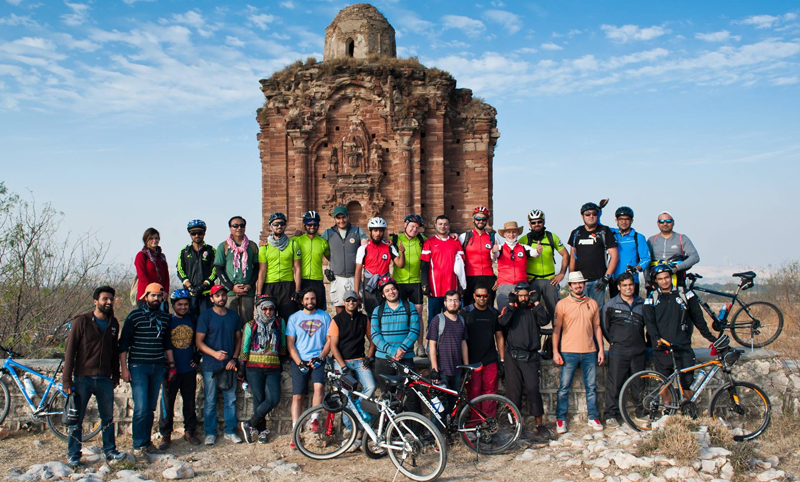
The MTBI is currently the sole official group of men and women, seeking thrilling rides, doing cross-country and trail-riding. Speaking to their reps was quite incredible. The group gained international popularity amongst cyclists when they started to feature in international sites such as singletracks.com and became viral in videos featured by the Global Mountain Bike Network, which is a worldwide community for Bikers.
Requirements for being a part of the group? Bring your helmet, a mountain bike, your grit and yes, an absolute mindset to join in synchronicity with the thought that these people are here to ride those trails! Social networking is, of course, done apart from that, but the focus at the meet-ups is to get out there, cycle and push your limits and willpower further with each new adventure ride.
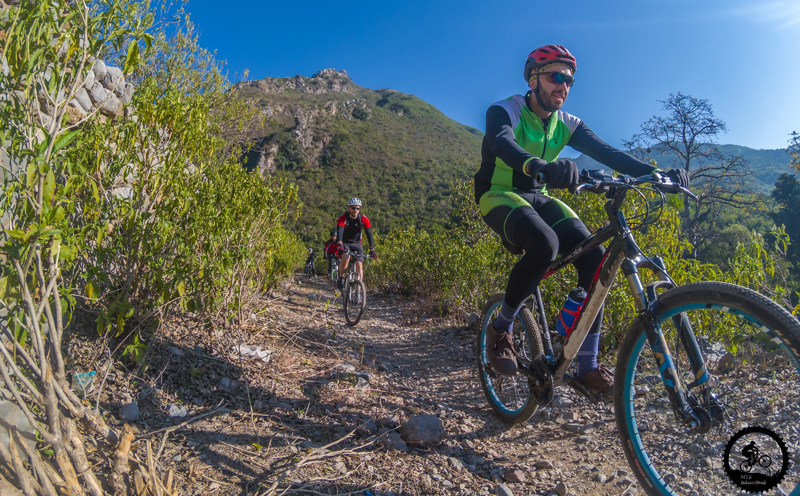
Once called a sleepy city, it seems to have a plethora of thrill-seekers here, finding some pretty exciting ways to nurture a hobby. What was just a small conversation amongst four friends mulling over things to do in Islamabad has turned out to be an official group. The friends who were the initial core admins, Kamran Hashmi, Omar Haroon, Rohan Mirza and Naveed Rahman, were already part of one of the regular Critical Mass chapters (one of the first cycling clubs). However, the need for something slightly more over-the-edge was calling out to them and the passion for the sport has now become a staple part of their routine life.
Mountain biking, unlike cycling on designated roads, is quite different and difficult. Usually termed as an extreme sport (All Mountain Biking), it gives a more of an adrenaline rush than just cycling on levelled roads and provides this crowd with the “buzz.” Riding on trails, you need endurance and perseverance as well as an adventurous spirit. In Pakistan, the group mainly does two forms of mountain biking: cross-country and trail-riding. They have both uphill and downhill routes. Asked about the preference in the type of ride, most of the group members replied with a grin, “Mountain biking downhill, of course!”
Kamran Hashmi, the main admin and an Engineering teacher at COMSATS University, is a local from main Islamabad. Having grown up walking and hiking through the trails, he knew they could do this given every member was game to volunteering their part as a troupe.
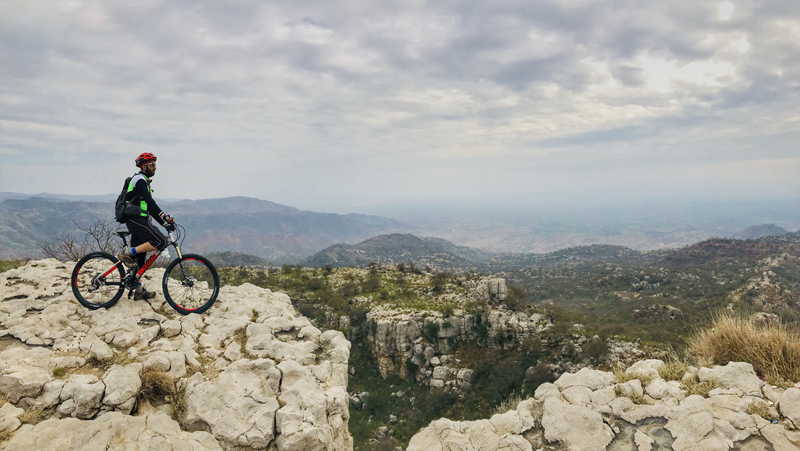
Currently, he is now giving training workshops to those wanting to start cross-country riding. So an obstacle course is set on level ground for beginners and then easy startup trails ride from the point of the grounds. If you require information about bikes and local places, they will provide you with that info as well.
I noticed a few women mentioned in the group as well and I managed to speak to one of them, who is a keen biker and often rides with MTBI. Zehra Kamal, one of the pioneering members from the Critical Mass Chapter, since 2010 states what cycling means to her. “For me, it is very energising and exhilarating doing this, and a big sense of freedom to take out my bike and go wherever I feel like. I didn’t face any challenges when it comes to the group’s dynamics perhaps because I’ve been doing this for years and people here know what we are all about.”
Usually termed as an extreme sport, All-Mountain Biking gives more of an adrenaline rush than just cycling on levelled roads
Margalla Hills are full of winding trails, which connect to different villages through the hills and valleys. Most of the trails are narrow walking trails while some are called “jeepable” or concrete road. These are all considered tenable for off-road cycling and also known as mountain biking. Even though this is not All-Mountain Biking, which comes into the category of extreme sports, it can still be risky as the terrain will not give you moments to revise a split-decision made whilst cycling. Bikers must be prepared for anything. Even something such as a weather change can affect the type of route taken and the ride itself.
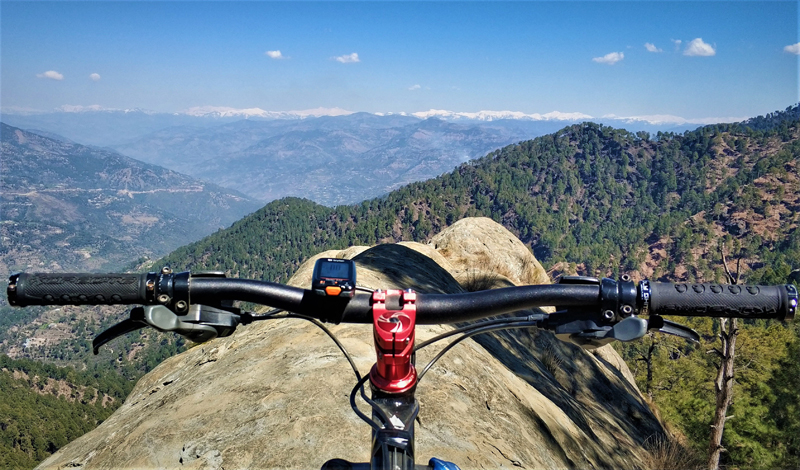
The central weekly meeting point is usually the F-9 Park (Islamabad City) and then, the cyclists head out, usually at sunrise. For more remote or far distances, they hire vehicles to reach the venue. The vehicles are usually used as support cars for the ride and stay behind the group at all times. This is a common practice for safety. They are well aware of safety protocols; carrying first-aid kits and riding in a formation. The ride coordinator, which is the head admin, leads the way and a rider at the tail of the group, called the sweeper, makes sure nobody is left behind.
Some of the remote routes have taken them as far as the Galiyat region, Hunza Valley, Neelum Valley, Swat and the Panjpir Rocks (a very difficult trail, referred to as the Moab of Pakistan by cyclists). These are set at distances of up to 60 km or more and the mountain bikers have ridden for two to three hours at a stretch at points. Strenuous yet exciting, exhausting but memorable, and most of all, adrenaline-charged, and that is exactly why all these folks signed up for this.
So, if you are looking for that extra zest to add to life in Pakistan and happen to find your way to Islamabad, do look these guys up. They would be the perfect crew that would host an adventure ride to some of the most beautiful places here with a great crowd.


0 Comments